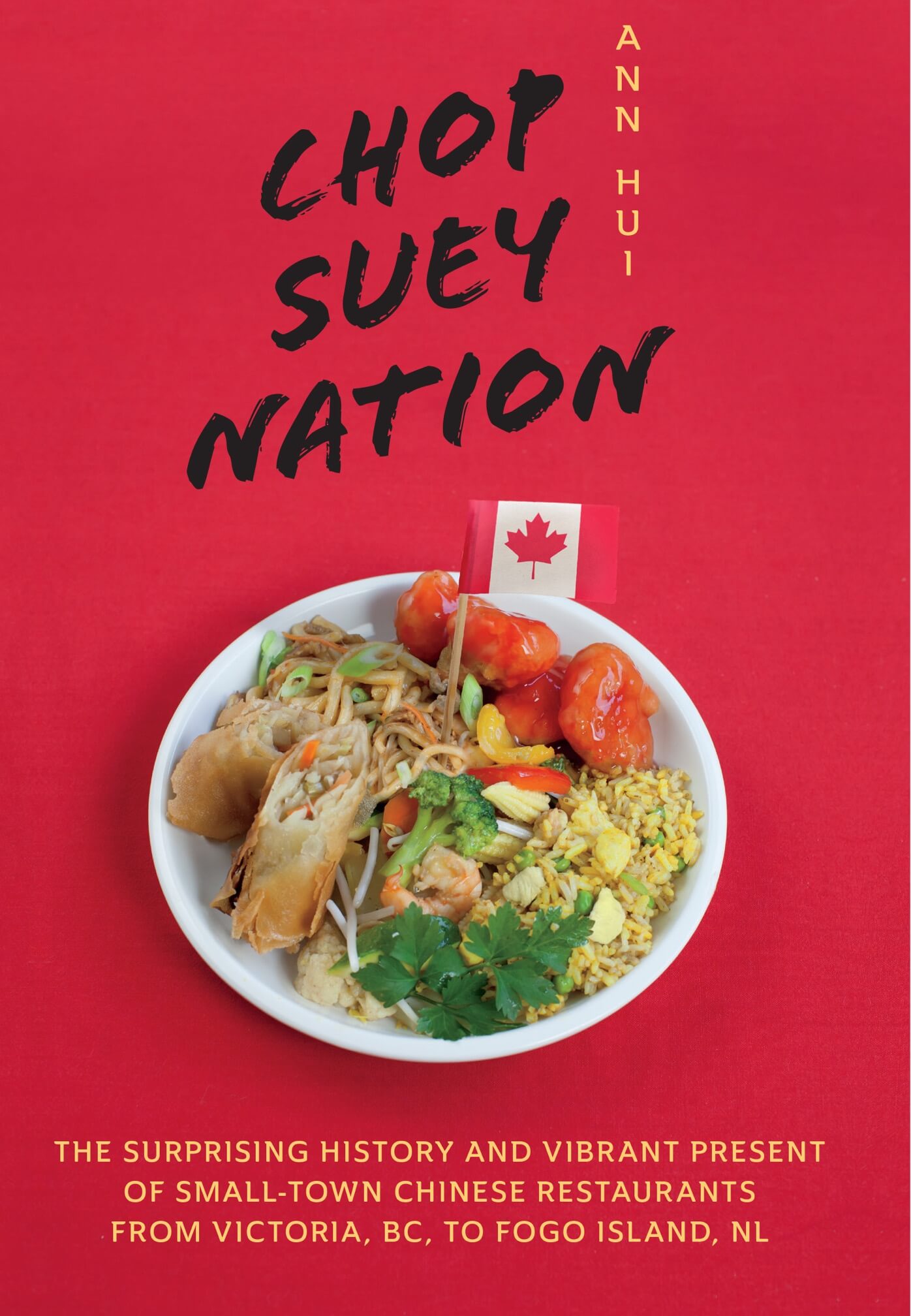
There’s a genuinely good book buried inside Chop Suey Nation. Ann Hui drove across Canada and sat down with dozens of Chinese restaurant owners in small cities and towns — places where the local Chinese restaurant is often the only one, and has been for decades. Those interviews are the heart of this book, and at its best, they’re poetic. These are people with real stories: long hours, family sacrifice, the particular loneliness of running a restaurant in a place where you’ll always be a little bit of an outsider.
When Hui lets those stories breathe, the book sings. And it makes it all the more frustrating that so much of the rest of it falls flat.
The Question the Book Never Answers
Throughout Chop Suey Nation, Hui is determined to answer a deceptively simple question: why do Chinese restaurants across Canada all seem to serve the same dishes?
It’s a great question. The easiest answer — that these restaurants adapted their menus to cater to small-town Canadian tastes — is probably mostly right. But a good journalist would push past that. Hui doesn’t. There are times when I thought she was going to show me something original — like when a new owner took over the recipe books from the previous-previous owner and made the the most economical decision to keep things as is; or when she found out about the origin of ginger beef from an Edmonton restauranteur; or when she cited a UBC history professor that immigration is “nodal”, as in moving in nodes — but she just stopped.
By the end of the book, we’ve circled the question many times without getting meaningfully closer to an answer. It’s a missed opportunity that hangs over the whole project.
The Writing Gets in Its Own Way
Hui weaves her family’s story — her parents and grandparents, their immigration from China, the poverty and family feuds they left behind — through the present-day interview chapters. This structure could work in theory.1 In practice, however, the family history chapters feel thin. Her family wanted a better life. They faced hardship. There were conflicts. These are real and valid experiences, but Hui doesn’t situate them in any larger context. She touched the waves of Chinese immigration to Canada — the key historical events and geographical origins — but the grand scheme of things is disconnected with her own family’s story.
There are things that I find hard to believe. Hui opens that that she didn’t know about his father’s involvement in the food industry until she was in high school, or that she didn’t know the family owned a cafe in Abbotsford that had Chinese items on the menu. Hui’s father was coy and elusive about the family’s past, and the stories of how he and his father got to Canada, but then Hui went on writing chapters of detail-rich stories of unrecorded family history. The result is chapters of family story that feel thin and reads like based-on-a-real-story fiction .
Then there’s a more granular problem with her storytelling. Chapter Eleven: Thunder Bay, ON is a good example. Hui casually introduces Ms. Norina Karschti as the daughter of the owner of Ling Lee’s, a Chinese restaurant in the city:
Mr. Lee was hardly a stranger to bold decisions, his daughter, Norina Karschti, told me. She was working in the kitchen of Ling Lee’s when we walked into the restaurant.
A reasonable reader pictures a teenager helping out at the family business and started chit-chatting with Hui. The German last name is puzzling, but we’re given no help. A few paragraphs later we learn Norina runs the restaurant. Only near the end of the chapter do we find out she’s in her fifties and her youngest child is nineteen.
Building suspense in nonfiction can work — you follow the interviewer’s perspective as it unfolds. But that only works if the author genuinely didn’t know what she was walking into. Hui clearly knew. She knew she was talking to a middle-aged woman who had taken over her family’s restaurant. Withholding that just leaves the reader constructing a wrong picture, then having to silently correct it. It’s disorienting.
And the Norina Karschti story deserved so much more. Here’s a woman who spent decades trying to “get as far away as possible from the restaurant life”, only to end up running it — and now she’s getting her own kids involved too. What changed? What does her white husband make of it all? Hui didn’t ask, or if she did, she chose to not tell us.
This is the pattern throughout the book: the author arrives at the edge of something genuinely interesting and then doesn’t step over.
Carelessness with Chinese Culture
This is where I have the most to say, and I want to say it carefully, because it’s also the most pointed criticism.
The book is, at its core, about Chinese culture in Canada. That makes it all the more noticeable that Hui handles Chinese language and terminology carelessly. Chinese terms are romanized inconsistently throughout — sometimes in Mandarin Pinyin (liangpiao2, jingweicun3 are spelled correctly), sometimes in approximated Cantonese (bak tseet guy, siyup, char suee bok toy) — at times in adjacent paragraphs, with no acknowledgment of the difference. The Cantonese spellings don’t follow standard Jyutping4. For readers who care about this, it reads as sloppy; for those who don’t, it quietly spreads that sloppiness forward.
It wouldn’t have taken much to fix. A footnote with the Chinese characters would suffice. So would a note on romanization alternatives. She also should have expanded with a brief discussion on the nuance of Chinese languages and scripts. None of that is here.
There’s also a small but telling moment where Hui mentions a maneki-neko sitting in the Chinese restaurant in — the waving cat figurine common in Chinese restaurants — without noting that it’s actually Japanese in origin. The existence of a Japanese symbol in a Chinese restaurant, the fact that the Chinese name of the cat is literally “wealth-inviting cat”, not “lucky cat”… Those points are worth unpacking; at least they merit a casual remark or a footnote. Hui didn’t bother.
I have a few theories:
-
Taken together, these moments suggest an author who is more comfortable writing about Chinese culture from the outside than engaging with it on its own terms. That’s a strange quality in a book that clearly wants to be a loving tribute.
-
Hui is lazy and sloppy with her investigation and journalism. There’s an example unrelated to the Chinese culture: Hui writes that the car rental girl in Victoria, BC was astounded that Hui was dropping her car off all the way across Canada in Deer Lake, Nova Scotia. Hui writes she didn’t bother correcting her (that Deer Lake is in Newfoundland and Labrador, not Nova Scotia). Later in the book, in the endnote photo caption, she writes Deer Lake, NS as in Nova Scotia.
-
Hui is not as familiar with the Chinese culture as she wants you to believe. She needs the talking point for marketing that this book is an insider’s take, but her work misses the mark.
I don’t want to be too harsh, because I find the interview chapters delightful. There’s warmth and genuine respect for the people she interviewed, and it’s commendable that their stories are recorded and put together.
But if you come to the book with familiarity with Chinese culture, or with high expectations for rigorous journalism, you’ll finish it feeling like you’ve seen the shape of something important without ever quite touching it. The curiosity that would have made this book great — the follow-up questions, the deeper digs, the investigative journalism — is poignantly absent.
Ironically, this book fits its title: it’s chop suey, a medley of whatever materials that happen to be available.
-
And it did work for other books, such as Other Rivers by Peter Hessler, of 2024. In the book, Hessler weaved his family story and connections to China from generations past. His writing was compelling and genuine, and the past stories weaved organically into the present-day ones. ↩
-
Hui did not expand on the background of liangpiao, or 粮票 — these are the quota tickets for food and life supplies in the old planned economy. ↩
-
And thanks to Hui’s lack of a footnote, I can never figure out if Jingwei is 经纬, 敬畏, 精卫, or 泾渭. Google wasn’t helpful. The letters cun is literally village, and these four words carry the following meanings, respectively:
- Longitude and latitude (or geo coordinates), wouldn’t be an absurd village name
- Awe, or respect to a higher being. Also wouldn’t be an absurd village name
- A protagonist in a Chinese fable, highlighting mankind’s perseverance. Quite an educated name choice.
- The names of two fictional rivers — one muddy, and one clear — that confluence. I can see a nonfictional village named after them.
-
When I searched these spellings, Google was smart enough to display the correct results (the geographic region or the dishes such as), but I never once see those spellings show up.
For example, what Hui calls siyup is siyi in Pinyin, or sei3 jap1 in Jyutping, as listed on Wikipedia. Hui’s spelling was not found anywhere on that page. ↩